
May
Tramadol Guide
What is Tramadol? Uses, Dosage, and Mechanism of Action
| Buy Tramadol Online | Buy Tramadol 100mg Online US to US |
| Buy Tapentadol 100mg Online | Buy Citra Tramadol 100mg Online |
Introduction to Tramadol
Tramadol is a synthetic, centrally acting analgesic prescribed to manage moderate to moderately severe pain in adults. Unlike over-the-counter pain relievers such as ibuprofen or acetaminophen, tramadol works directly within the central nervous system to alter how the body perceives and responds to pain signals.
First approved for medical use in the 1990s, tramadol was initially positioned as a safer alternative to traditional, stronger opioids. While it is highly effective for many patients, ongoing clinical research has revealed that tramadol possesses a highly complex pharmacological profile. Understanding exactly how this medication interacts with the body is crucial for safe and effective pain management.

The Mechanism of Action: How Tramadol Works
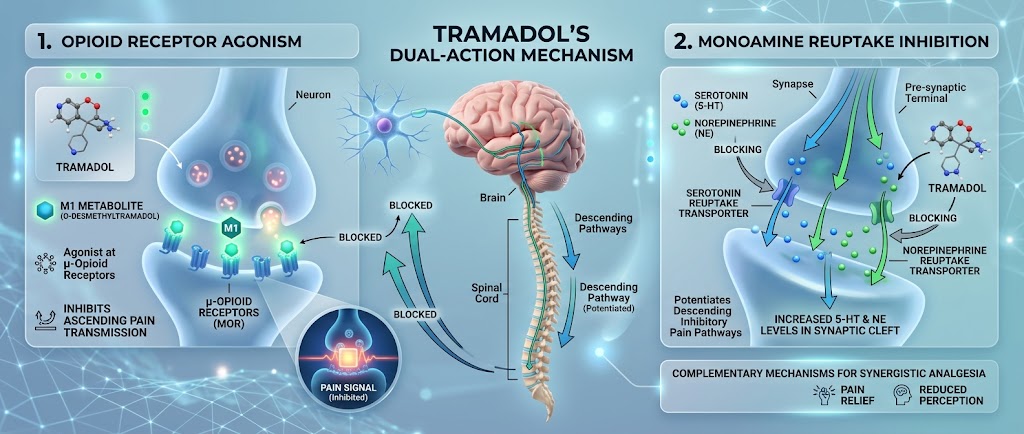
What makes tramadol unique among pain medications is its dual-action mechanism. Instead of relying on a single pathway to block pain, it attacks pain signals on two different fronts simultaneously.
1. Weak Mu-Opioid Agonist The primary way traditional painkillers work is by binding to mu-opioid receptors in the brain and spinal cord. Tramadol also binds to these receptors, but its affinity is relatively weak compared to stronger medications like hydrocodone or oxycodone. When tramadol or its active metabolite binds to these receptors, it disrupts the transmission of pain signals, providing widespread pain relief.
2. Serotonin and Norepinephrine Reuptake Inhibitor (SNRI) The second part of tramadol’s mechanism mimics the action of certain antidepressant medications. It inhibits the reuptake of two crucial neurotransmitters: serotonin and norepinephrine. By keeping higher levels of these chemicals active in the brain’s synaptic clefts, tramadol enhances the body’s natural pain-inhibitory pathways. This SNRI property makes tramadol particularly useful for treating complex pain syndromes, including certain types of nerve pain.
Metabolism and the Role of the Liver
To fully understand tramadol, one must understand how it is processed. When a patient swallows a tramadol tablet, the parent drug itself is not responsible for the majority of the opioid-like pain relief.
The drug travels to the liver, where it is metabolized by the cytochrome P450 enzyme system, specifically the CYP2D6 enzyme. This enzyme converts tramadol into its active metabolite, known as O-desmethyl-tramadol or M1. The M1 metabolite binds to the opioid receptors significantly more strongly than the original drug. Because liver enzyme levels vary drastically based on genetics, some patients process tramadol too quickly experiencing toxicity, while others process it too slowly experiencing no pain relief at all.
Primary Clinical Uses
Healthcare providers utilize tramadol across a variety of medical scenarios where standard non-steroidal anti-inflammatory drugs NSAIDs are insufficient.
- Post-Operative Pain: Frequently prescribed for a few days following surgeries to manage acute recovery pain.
- Osteoarthritis: Used to manage chronic joint pain in patients who cannot tolerate NSAIDs or for whom standard treatments have failed.
- Fibromyalgia and Neuropathy: Due to its SNRI effects, doctors often prescribe tramadol off-label to help manage chronic nerve pain and widespread musculoskeletal pain.
- Injury Recovery: Prescribed for acute trauma, such as severe sprains or fractures, during the initial healing phase.
Standard Dosage Guidelines
Dosage always varies based on the patient’s medical history, age, liver function, and the severity of the pain. The medication is available in immediate-release and extended-release formulations.
- Immediate-Release: The standard starting dose for adults is typically 25 mg to 50 mg every four to six hours as needed for pain. The maximum daily dose for immediate-release tramadol generally should not exceed 400 mg per day.
- Extended-Release: For chronic pain requiring around-the-clock treatment, extended-release tablets are used. These are typically taken once daily, starting at 100 mg, and titrated upwards cautiously. The maximum daily dose for extended-release formulations is generally 300 mg per day.
Older adults and patients with hepatic or renal impairment typically require lower initial doses and extended dosing intervals to prevent drug accumulation and toxicity.
Conclusion
Tramadol is a highly versatile and uniquely formulated medication that bridges the gap between standard anti-inflammatories and potent traditional opioids. By leveraging both opioid receptor binding and neurotransmitter reuptake inhibition, it offers robust relief for a variety of pain conditions. However, due to its complex liver metabolism and direct effects on brain chemistry, it requires strict adherence to prescribed dosage guidelines to ensure patient safety.
